
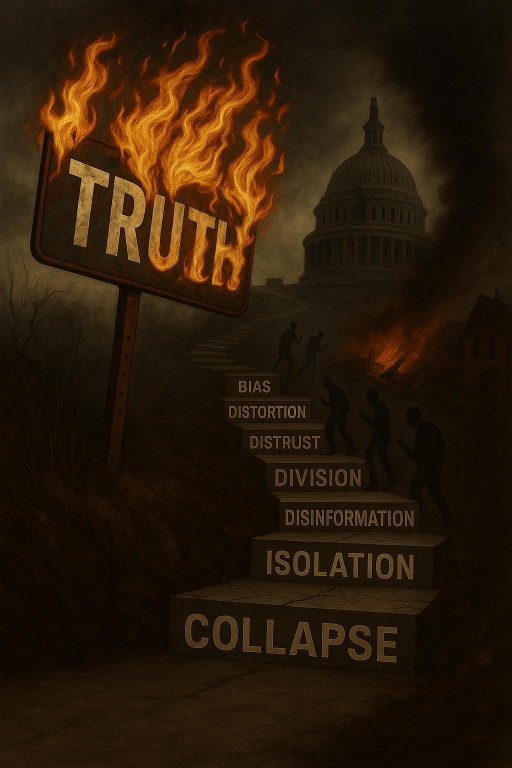
We are lied to. Constantly. Relentlessly. In ways both brazen and subtle. By people we expect to lie and by institutions we once trusted.
Lying has become the default setting of American life. It is no longer the exception, it is the rule. We have successfully normalized deceit. It is now pervasive and habitual. Because of that even the truth gets dragged into doubt.
We all know politicians lie. Party affiliation does not matter. Politicians spin, distort, and omit to fit their narratives and secure our votes. They condemn and outlaw the behaviors they themselves practice. Democrats accuse Republicans of starving babies; Republicans claim Democrats support near-full-term abortions. One side says the other wants to ban birth control; the other says their opponents want to fund freeloaders. None of these claims are remotely true. Yet millions believe them.
We are told schools can improve with less funding. That vaccines are a personal threat rather than a public health tool. That wearing a mask during a pandemic is a free speech issue. We are told the myth that private enterprises always outperform the public sector—objectively false, yet endlessly repeated.
Entire industries are built on deception and misdirection. Ever file an insurance claim? Then you know: the sales pitch was a lie, the process is a maze, and a fair chunk of your premiums help pay your agent’s commission, not just your coverage. Manufacturers, food processors, and Big Pharma routinely obscure risks, minimize side effects, and lie until they are forced by regulators to recall products. Even multi-billion-dollar consumer sectors—cosmetics, deodorants, real estate, and auto sales all depend on selling illusions and/or misrepresentation.
Credit card agreements, mortgages, auto loans: all wrapped in dense, unreadable legalese designed to confuse, not inform. The same goes for online terms and privacy policies. We click “agree” because we have no real choice, and they count on our fatigue.
Social media thrives on distortion. Truth is malleable. Everything is curated to confirm our biases. And we all know it.
Cable news and internet pundits lie because lies make money. Ratings, clicks, engagement, they all rise with outrage. News outlets often cater to their audience’s worldview rather than challenge it. Facts take a backseat to narrative.
Then come the institutional lies. Governments cover up foreign operations, massage economic numbers, demonize opponents, and, yes, some even cast doubt on election results. We have gone as far as to label money “free speech.” That may be the biggest lie of all.
At the local level, cities obscure the quality of drinking water. Contracts get awarded in the dark. Building inspections get rubber-stamped. Polluters hide behind legalese and finger-pointing.
People fudge numbers on loan applications or lie about affairs. But lies are like habits—they spread.
Not all lies are malicious in intent. Parents conceal unwelcome news to spare their kids. But in the encyclopedia of lies it is one of a trillion entries.
Senator Daniel Patrick Moynihan once said, “You are entitled to your own opinions, but not your own facts.” But today, the line between fact and fiction has eroded. We no longer trust the information we get—or even each other.
So, when something goes wrong, our first instinct is to blame someone else. We have internalized the lie.
This is why civil discourse so often collapses into shouting. Why disagreement feels like betrayal. This is the root cause of our circles of friends growing smaller and our conversations more guarded.
I do not pretend to have all the answers. But here are a few steps that might help:
- Restore the fairness doctrine and equal time rules in political broadcasting.
- Treat public lying as perjury. Make truthfulness a core civic expectation, with consequences for violations.
- Define and restrict extreme hate speech. Exempt it from First Amendment protection and make it a felony.
- Reinstate and empower the Consumer Financial Protection Bureau, the DOJ’s Public Integrity Unit, and the Government Accountability Office. Strengthen oversight and coordination with the FBI.
- Treat social media platforms as publishers thus making them accountable for the content they disseminate.
- Consider a constitutional amendment requiring elected officials to speak truthfully—at every level of government. The penalty for violation: removal and permanent disqualification from office.
We deserve better. And that starts with demanding the truth. From everyone. Including ourselves.

 Adult Language Is Possible